I wrote the post below in 2015. I share it today because in an era where DEI and the values it represents are under deep scrutiny, it is useful to recall that progress in America is always a complex topic.
In Arizona - we became the first state to refuse to honor Dr. Martin Luther King by creating a state wide holiday. A couple of years later, however, Arizona became the first and only state to vote to honor the courage of Dr. King.
Thanks for reading my Substack! Please subscribe to help me improve my observations and insights on the challenges that face our society.
Here is my post from more than a decade ago. I think it is as true in 2026 as it was in 2015.
“While I was in graduate school for my MBA, I read for the first time Dr. Martin Luther Kings Letter from a Birmingham Jail from April 16, 1963. This letter may seem like unusual reading for MBA students and mostly dedicated capitalists, as Dr. Kings letter addressed themes of leadership and social justice.
After reading the view of local clergy, Dr. King wrote his letter in the Birmingham Jail on scraps of paper and completed it on a legal pad provided by his defense attorneys. It is interesting to consider that an MBA program would require reading Dr. Kings letter, but as I share below his words are powerful reminders that the words and conduct of leaders are powerful.
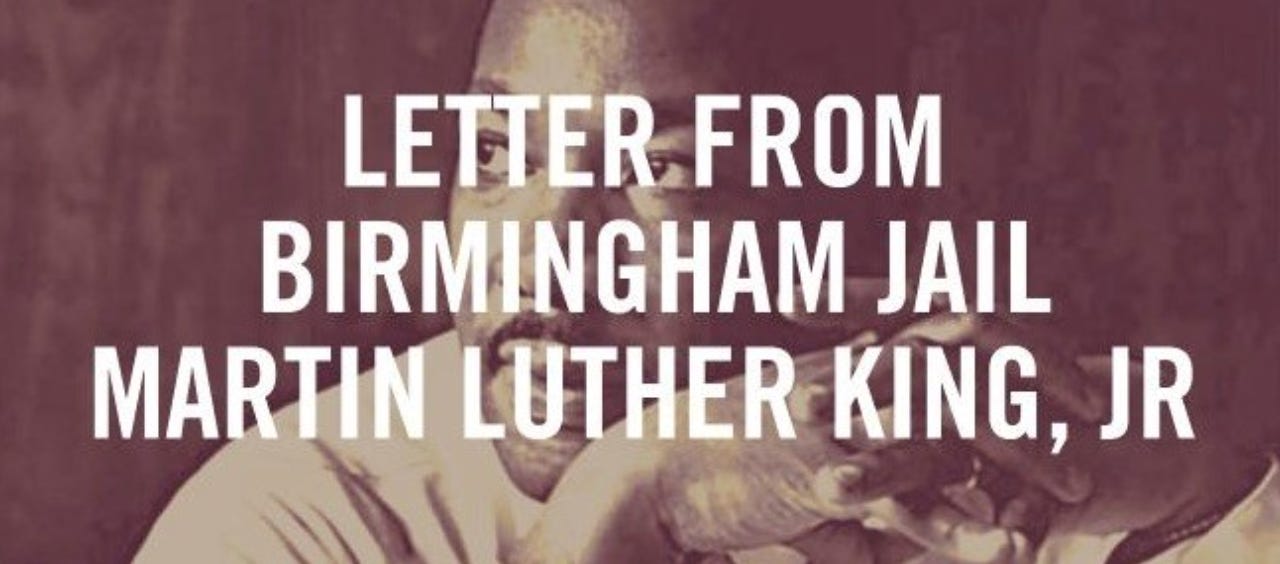
I encourage you to read the letter for yourself and consider the lessons on leadership that are contained within his well chosen words:
“I want to try to answer your statement in what I hope will be patient and reasonable terms. I cannot sit idly by in Atlanta and not be concerned about what happens in Birmingham. Injustice anywhere is a threat to justice everywhere. We are caught in an inescapable network of mutuality, tied in a single garment of destiny. But I must confess that I am not afraid of the word tension.
I have earnestly opposed violent tension, but there is a type of constructive, nonviolent tension which is necessary for growth.Lamentably, it is an historical fact that privileged groups seldom give up their privileges voluntarily. Individuals may see the moral light and voluntarily give up their unjust posture; but, as Reinhold Niebuhr has reminded us, groups tend to be more immoral than individuals. For years now I have heard the word Wait! It rings in the ear of every Negro with piercing familiarity.
This Wait has almost always meant Never. We must come to see, with one of our distinguished jurists, that justice too long delayed is justice denied.The nations of Asia and Africa are moving with jetlike speed toward gaining political independence, but we still creep at horse and buggy pace toward gaining a cup of coffee at a lunch counter.There comes a time when the cup of endurance runs over, and men are no longer willing to be plunged into the abyss of despair. I hope, sirs, you can understand our legitimate and unavoidable impatience.
One has not only a legal but a moral responsibility to obey just laws. Conversely, one has a moral responsibility to disobey unjust laws. I would agree with St. Augustine that an unjust law is no law at all.How does one determine whether a law is just or unjust? A just law is a man made code that squares with the moral law or the law of God. An unjust law is a code that is out of harmony with the moral law.
To put it in the terms of St. Thomas Aquinas: An unjust law is a human law that is not rooted in eternal law and natural law. Any law that uplifts human personality is just. Any law that degrades human personality is unjust.
Real leadership requires this understanding of justice and the courage to articulate and demonstrate such conviction. What is interesting to me is that leadership is fundamentally defined by having the courage to express your views - despite opposition, despite fear, despite overwhelming odds.
It is courage that defines leadership. Even though it may not have the same impact as Dr. King, re-reading the letter reminds me that business leaders need similar courage. In big and small things. We need the courage to speak the truth.Looking back it is easy to understand why Harvard Business School required 900 emerging leaders to read Dr. King. Dr. Kings letter is one of the best illustrations of expressing the courage required of leadership.
It is very difficult to appreciate the context for his arrest, the violence, and unrest that surrounded him - yet his letter captures so many complex emotions, speaks about enduring values and illustrates the courage that is needed by anyone who assumes the mantel of real leadership.
Do yourself a favor and take the time to read Dr. Kings entire Letter from a Birmingham Jail. Take from it what you will, but I hope that Dr. Kings example will inspire each of us to find the courage to give voice to the values we know to be true.
Thanks for reading my Substack! Please subscribe to help me improve my observations and insights on the challenges that face our society.