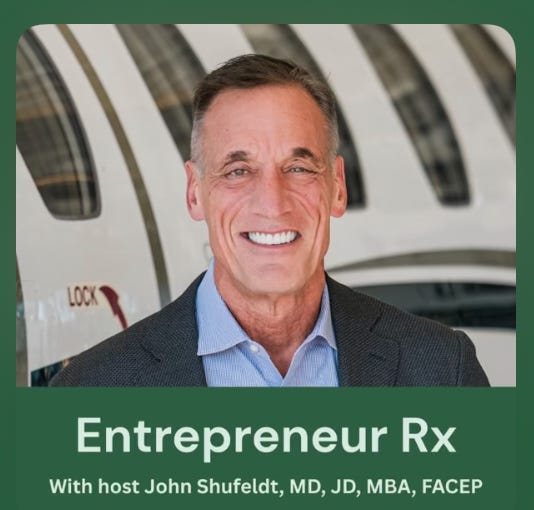
I recently joined Dr. John Shufeldt on Entrepreneur Rx. John usually talks with founders building healthcare companies. Our conversation took a different path. We talked about insurance, higher education and what it takes to build a company. The 30 minutes went fast.
Many of my Arizona friends know John’s name from the new John Shufeldt School of Medicine and Medical Engineering at Arizona State University. John is an ASU alumnus, physician and entrepreneur. His nine-figure gift, the second largest in ASU history, will help train physician-engineers and support health-tech founders. He is putting real money behind the problems he cares about.
John is an extraordinary person. He is curious and generous on the mic. I knew it would be a fast-moving discussion, but he often asked questions I didn't expect. He also talks honestly about his own mistakes. That makes the conversation useful. If you are building in healthcare, fintech or higher education, Entrepreneur Rx is worth your time.
The conversation captured on his Podcast is filled with diverse topics. We spoke about careers, founding companies, building GradGuard, workforce trends and risk. I hope you enjoy it as much as I enjoyed the discussion.
Rethinking the Risk of Paying for College
While the podcast discussion was far-ranging, we started with the question behind GradGuard. A college education is one of the largest purchases a family will make, making it one of the largest unprotected financial risks in society.
If you are a college parent, you likely know that most schools stop refunding tuition, housing, and fees a few weeks into the term. After that, a student who withdraws because of an illness, a death in the family, or a parent’s job loss may get nothing back. In 2025, nearly a third of colleges and universities operate with negative cash flow. Most cannot afford to return the money.
Withdrawals are not rare. For decades, the American College Health Association has found that about 2% of college students get mononucleosis or are diagnosed with a concussion each year. The National Student Clearinghouse reported that 113,000 students left school for legitimate reasons, including health conditions, in just one year. At $20,000 per student, families face about $2 billion in losses annually.
That is why Bill Suneson and I built GradGuard’s Tuition Protection Program. It is the only nationally available form of tuition insurance that provides a refund for tuition, housing, and academic fees when a student is forced to withdraw due to legitimate reasons. Before GradGuard, no public, historically Black or predominantly Hispanic institution offered it. Today we work with more than 700 colleges and universities and protect nearly half a million students. The scale of GradGuard’s national network of schools is essential to providing the most relevant protections at an affordable price.
How we pay for the talent we need
John shared a story about a family friend who left medical school mid-second year with more than $100,000 in loans. He graduated with about $100,000 of his own debt at 13% interest. That led to one of my favorite parts of the conversation.
I’ve long believed we made a mistake relying so heavily on conventional student loans to fund higher education. Australia offers a useful alternative: income-contingent loans repaid through the tax system, combined with lower student contributions in some priority fields. Singapore takes a different approach, relying more heavily on public subsidies and, in selected programs, service obligations tied to workforce needs.
We need more physicians, nurses and teachers. Yet we hand a young doctor $400,000 of variable-rate debt, then wonder why people choose residencies based on loan payments instead of community need.
John isn’t just talking about this. His gift to ASU’s new John Shufeldt School of Medicine and Medical Engineering will fund scholarships and loan relief for future doctors. He told me he wants ASU to compete for the best students, like tuition-free programs such as NYU’s. I’d love to help.
Building High Potential Ventures in Arizona and beyond
John and I are both ASU alumni. We traded stories about Harvard, mentors and my decision to build our first business in Boston. When I left Harvard Business School in 1999, mentors in Arizona told me the startup community there was not ready. They were correct.
In 2000, Boston was an ecosystem that included the talent, expertise, and capital vital for increasing the odds of success.
Today, Phoenix has these same qualities and, importantly, a mindset that welcomes innovation and new designs where collaborations are an additional source of value - such as building a “School of Medicine and Medical Engineering”.
Indeed, Arizona has many advantages today. Arizona’s flagship universities are powerful magnets for top talent and high-achieving students. ASU’s Fulton Schools constitute the nation’s largest engineering program by enrollment and one of its largest producers of engineering and technology graduates.
New investment funds, including those that work through John’s investment fund, Xcellerant Ventures, Gregg Scoresby’s Phoenix Ventures, and Jack Selby’s Copper Sky Capital (formerly AZ-VC), have helped. Ideas and talent matter. Capital is often the catalyst.
Why I listen to Entrepreneur Rx
John has done the work. He is an emergency physician who still calls medicine the best job in the world. He is also a lawyer and an MBA. He founded NextCare Urgent Care in 1993 and later founded MeMD. He built both at scale. Now he backs other founders.
His work goes beyond business. He is investing in ASU and the future of healthcare. John told me about treating a patient on the San Carlos Apache Reservation, 90 miles from Phoenix. The patient had a CPAP machine but no electricity to run it. That experience drew John into Indigenous healthcare. It still shapes how he thinks about access.
John is many things. He is a leader, entrepreneur, and intellectual. He is also a serious reader. He has read more than 800 books and keeps a record of them at JohnsBooks.com. I wish I had thought of this idea, but he beat me both to the idea and the URL. If you want to see what lifelong learning looks like, start there.
Stay tuned; I am cataloging my own book collection.
You can find Entrepreneur Rx wherever you listen to podcasts. Learn more about John’s investing at XcellerantVentures.com.
Thank you, John, for the conversation and for the good work. Arizona is fortunate to have your leadership and our entrepreneurs will certainly benefit from the direct investments you make and also the investments in this Podcast that feature some unvarnished truths of building high potential ventures.
Thanks for reading. Subscribe for free to get new posts and stay in touch with topics I think are worth our attention.