A few years ago, Patricia Beaty and Lin Phillips came to see me as they finished their book “Growing Up In Arizona: Remembering the Past,” published by ASU about the life of Lattie Coor, the man who led Arizona State University through the years that shaped mine.
Lattie was a consequential leader of ASU. Serving as president of ASU from 1990 to 2002. Under his 12-year tenure, ASU launched Barrett, The Honors College, established the Polytechnic campus and raised more than $560 million in the ASU Campaign for Leadership, increasing the number of endowed faculty chairs from six to 80. In a major milestone, ASU earned Research I status in 1994 from the Carnegie Foundation for the Advancement of Teaching.
Our conversation sent me back through a decade of moments I had never lined up before. When I did, a pattern emerged—small nudges, kind words, patient corrections offered to a young man who was often wrong but never in doubt.
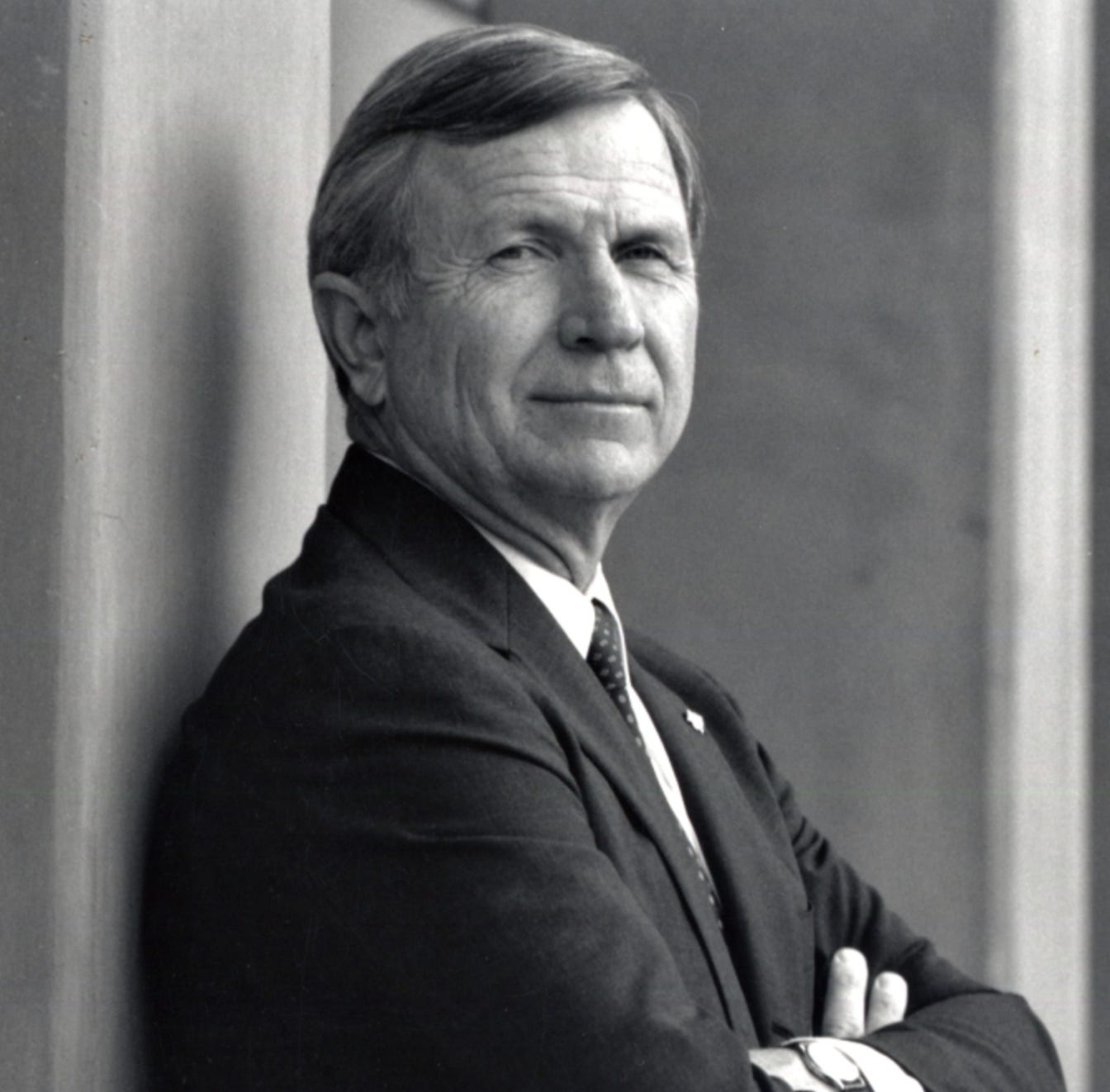
So I wrote Lattie a letter. What follows is a shorter, public version of it: part thank-you, part reminder to myself.
I first met Lattie in a private dining room at the Phoenix Ritz-Carlton. It was 1988. I was twenty-one, and as student body president, I was asked to serve on the presidential search committee for ASU.
The other people in that room were some of the finest I’ve ever spent time with—Herman Chanen, Molly Broad, Esther Capin, Jose Cardenas, Al McHenry, Don Kirkman, Kristin Valentine, and Jack Pfister among them. For a twenty-one-year-old history major, interviewing candidates of that caliber wasn’t a committee assignment. It was a capstone course I didn’t know I had enrolled in.
Looking back, the choice seems easy, though it didn’t feel that way at the time. The field included Gordon Gee and Condoleezza Rice. But hearing Lattie’s story convinced me that Arizona would be best served by his leadership. He was a superintendent’s son, like me; a former student body president at NAU; a man who had imagined a bigger life from a modest start and then gone out and built it. Listening to him, I began to imagine new possibilities for my own.
When it became clear that Lattie was the front-runner, I joined a small subcommittee that flew to Burlington to speak with his colleagues at the University of Vermont. Our hosts had arranged a full day of structured conversations in a conference room. About an hour in, I grew restless and asked if I could walk the campus.
I stopped students, staff—anyone who would talk to me—and asked what they thought of President Coor. Everyone said some version of the same thing: great, accessible, the real deal. But the person who sold me was a landscaper. When I asked about President Coor, he lit up. “Oh, Lattie—he’s just great.”
No title. No distance. Just Lattie.
That combination—first-name approachability joined to serious intellectual heft—distinguished him not only as a candidate, but throughout his tenure.
I had a few jobs post-college, and while working in private industry, I volunteered with the ASU Alumni Association. Seeing Lattie at university events, he encouraged me to consider a career in higher education. With help from several other mentors, I was hired as associate director and chief operating officer of the university’s alumni association.
I was still in my twenties: headstrong, not fully formed, and more certain than I had any right to be. Lattie was gracious to me anyway—every single time. We traveled together, hosted alumni events, shared long meals, and worked closely to advance his vision for the university.
I was on campus for only three years, from 1993 to 1996, but I remain proud of that stretch. I co-chaired the committee that created the sunburst logo ASU still uses some 30 years later. We helped bring the first Super Bowl to campus and expanded the Medallion of Merit program to attract more National Merit students.
Eventually, I also learned something important about myself: for all my belief in the transformative power of higher education, I didn’t have the temperament—or the patience—to make a career of it.
Somewhere along the way, on one of our trips, I asked Lattie for career advice. His answer was simple and perfect: “Don’t stress. As long as you don’t do something illegal, you cannot make a fatal career mistake before you’re thirty.”
I was twenty-six. I’ve since repeated that advice to my own children.
There is plenty more I could tell you. Lattie came to my wedding when I married Melissa Soza, my best friend from college. Around the same time, he and Elva began dating, and the rest of us delighted in watching them dance with us at university functions—to Tony Bennett after a Super Bowl performance, or in a country two-step after an ASU barbecue.
In 1996, I left ASU to support Melissa through her doctoral work at Harvard. Our first two boys were born there. I finished my MBA and co-founded my first business, working to build the first of several innovative solutions for colleges and universities.
But the lesson I most want to pass along is one Lattie delivered from the stage, again and again, to audiences large and small. He called his remarks “the shortest commencement address of any university president in America.”
It had two points.
Keep learning.
No matter how well we’ve prepared you, he would say, we haven’t prepared you for the changes ahead. Develop an internal gyroscope—a zest for learning, an appetite for it. Keep adding to your skills. Explore and master new things: another language, an entirely new field. Do that, and you’ll discover one of life’s great secrets: If you keep learning, you can remain successful and vital at any age.
Help others.
Help others learn, just as family, friends, teachers, and counselors helped you. Help your brothers, sisters, and cousins. Get involved in your community. Continue the American tradition of neighbor helping neighbor. In doing so, you’ll discover another of life’s great secrets, one every parent and teacher knows: There is no greater joy than watching someone you’ve helped flourish. It transforms that person’s life—and enriches your own.
I’m fifty-nine now, older than Lattie was when we met, with five children of my own. I find myself wondering about the young men and women whose calls I should answer, whose small crises deserve the patience and warmth Lattie so freely gave me.
Remembering his influence is really an instruction to myself: Stay open to the people who walk into your life. Pick up the phone. Offer the nudge.
Lattie was never my professor. But he was a patient teacher, a mentor, and a model for how to serve a family, a community, and a circle of friends.
What his kindness taught me is the simplest possible idea, and the truest: Small things add up to a big life. The nudges, the smiles, the words of encouragement—they make all the difference.
Thank you, Lattie. Because of your kindness to me, I’ll spend the rest of my life trying to pass it on.
Thanks for reading. Subscribe for free to stay in touch with insights and observations that I hope will improve - even in small ways - life.