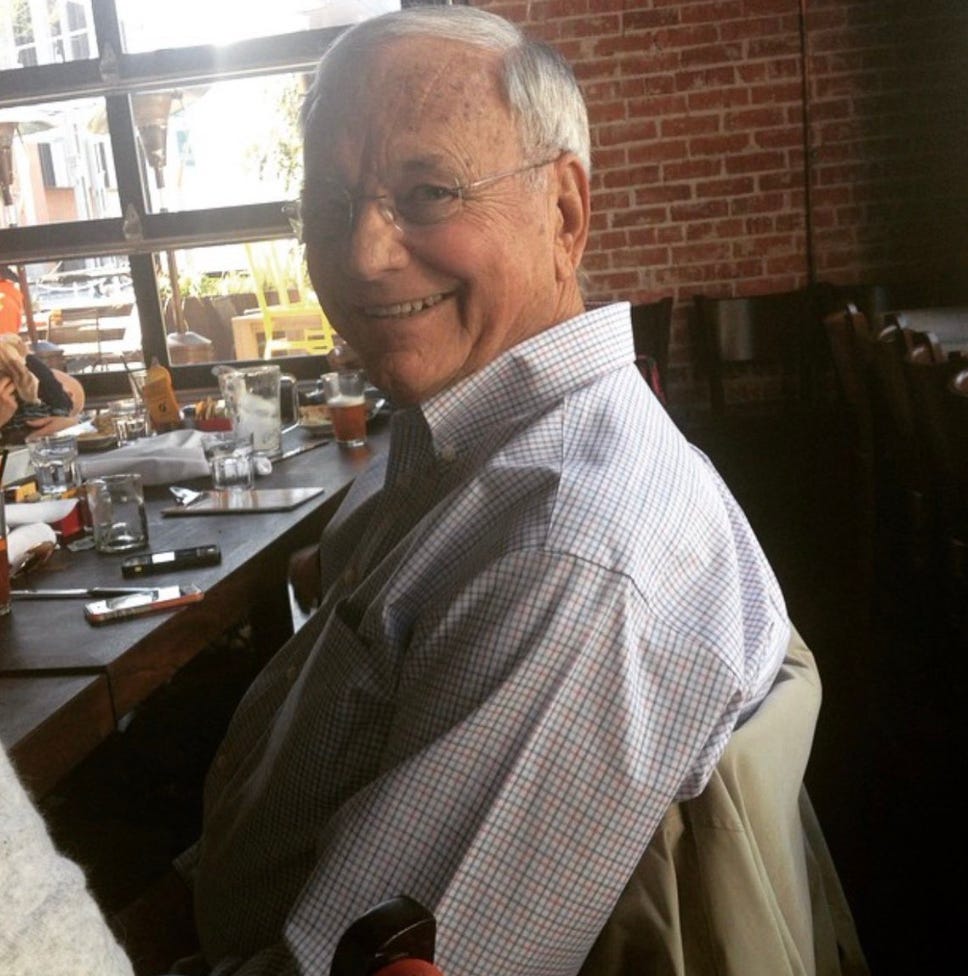
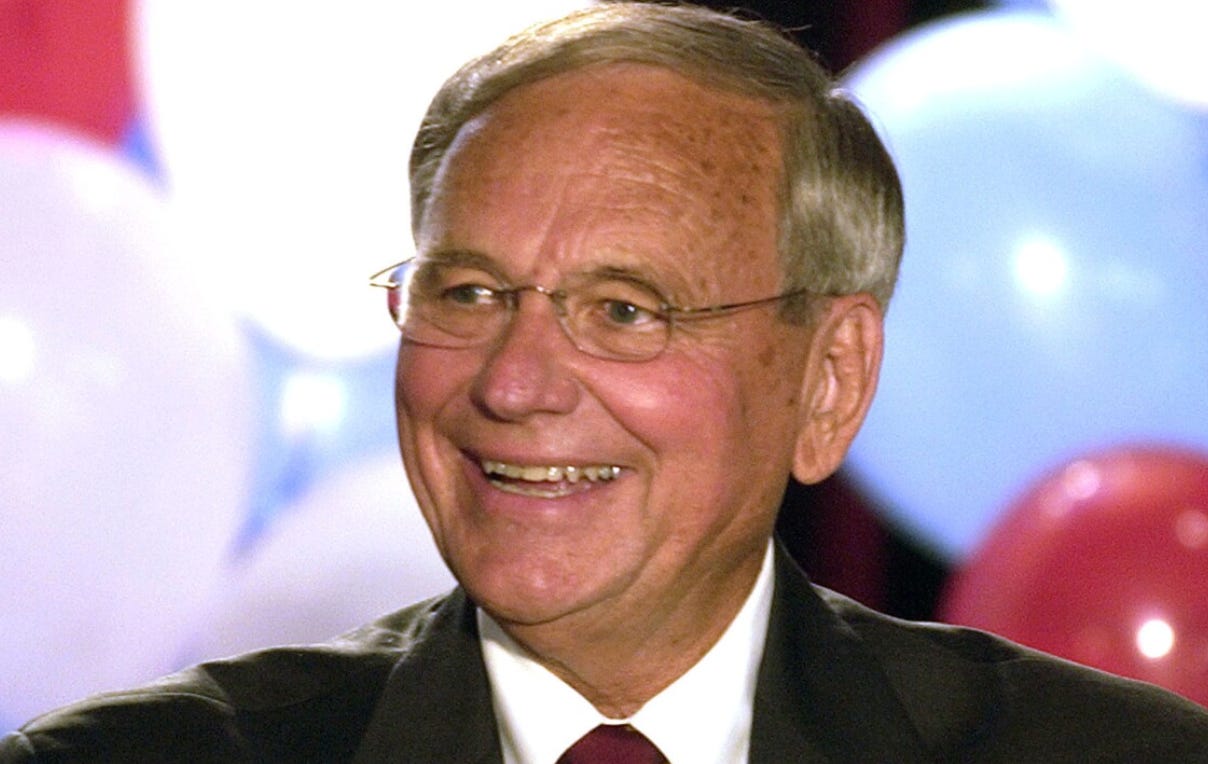
When I think of Harry Mitchell, the first thing I see is his smile.
Subscribe to my Substack to stay in touch and hear my observations on life, civics and the design choices we make as individuals and society.
It was broad and easy, the smile of a man who was actually glad to see you. Whether we ran into each other at a community event, at church, or—more and more, as the years went on—at the funeral of some old friend, Harry greeted me the same way every time: with warmth, and with a kind of respect that made you stand a little taller.
That smile told you most of what you needed to know about him. Harry paid attention to people. He made them feel welcome and valued. He did it as a teacher, a mayor, a legislator, a congressman, and as a husband, father, neighbor and friend. I was lucky enough to know him in nearly all of those roles.
I met him first through the Mayor’s Youth Advisory Committee. Bringing teenagers into the actual work of running a city was the sort of thing Harry did years before anyone thought to call it a good idea. Through the committee, and with the patient help of Tom Canasi, I started to learn how a community really works and how good leaders listen.
Tom once told me to “talk less and ask more questions.” I needed to hear it. By my second or third year I was asking more, and Arlene Chin had started driving me to City Hall so I no longer had to show up on my bicycle.
But Harry’s reach went well past City Hall.
For four years at Tempe High School he was my teacher and my student council adviser. I was one of thousands of kids who came through his classroom, and somehow each of us walked out believing our ideas mattered to him. He taught us free enterprise and economics, right down to the unglamorous business of balancing a checkbook. More than that, he handed us chances to lead.
Student council under Harry wasn’t a club. It was an apprenticeship. We organized dances and assemblies, traveled to statewide conferences, ran exchanges with other schools. Harry let us run with our enthusiasm and, without ever making a show of it, helped us build the judgment to turn our ideas into something real.
So many talented friendships were made in his leadership class, including Neil Martin, Cathy Mayorga, Kirstin Walker Tully, Holly Morris, Janee Rollins Gentrup, Nick Thornhill and Jolene Senn.
One of my favorite memories is a Coronation dance that the irrepressible Dub Dellis (senior class president in 1983) decided to turn our high school gym into a tropical paradise, waterfall included. After a full day of building it, the waterfall gave way and sent a small flood across the hardwood of the basketball court. It took just about every towel in the gym to soak it up.
Harry never lost his cool. That was him. He kept his footing even when the kids around him were creating chaos, sometimes literally.
Our class of 1985 was full of talent—Amy Mitchell, Guy Roll, Shauna Olsen, Debbie Hartin, Rachelle Faas, Amy Frischknecht Blodgett, Margo MacLean Rockas, Tina Akins, Brad Curtis, Rogelio Corrella, and plenty more. Harry believed in us, and he pushed us to pull in people from every corner of the school. He taught us that leadership had nothing to do with a title. It was about helping other people take part.
We learned a lot just by watching him run Tempe. He invited students to the Thursday night City Council meetings, and we got to see democracy up close. I couldn’t tell you what any single meeting was about, but I remember how much respect Harry showed the process—inviting anyone in the room to speak, hearing people out when they disagreed with him, keeping the whole thing calm without ever losing his grip on it.
He had critics, of course. Every leader who makes real decisions does. But Harry never confused disagreement with disrespect, and it showed.
Over the years, the calls made under his leadership set Tempe apart from the towns around it. The way the city treated its neighborhoods, its schools, its public art, its growth, and its friendships around the world through Tempe Sister Cities (Regensburg, Germany where I am returning from as I write this) - none of that was an accident. Harry and others spent decades laying that groundwork.
His biggest legacy, though, isn’t in any of those policies. It’s in people.
What Harry couldn’t have known back then was how complicated my life had gotten away from school. My parents were recently divorced; home was with a new family and stability more of an illusion than a reality.
I hid most of that. It was easier to stay busy than to explain, so I said yes to everything—the Youth Advisory Committee, Tempe Sister Cities, Key Club, Boys State, Boys Nation. And at nearly every turn and four years of student council, there was Harry, quietly in my corner.
A word of encouragement from Harry made me feel like I mattered. A bit of criticism made me better. Even when I ignored his advice, the way teenagers do, his steadiness meant more than he ever knew. His confidence in me helped me find my feet. The habits I picked up under him helped earn me an ASU Leadership Scholarship, and not long after, I was standing in front of the Arizona Board of Regents and Arizona Legislature with enough nerve—or nerve enough to be dangerous.
Almost none of that happens without the grown-ups who took me seriously first. Harry did.
His family shaped me too. Marianne—Harry’s beloved Marianne—taught Amy (his oldest daughter and a student council vice president for four years at THS) and me to type at the Mitchells’ dining room table. For as long as I knew them, the affection between Harry and Marianne was impossible to miss, and their marriage became one of the pictures I carried into my own life with my wife Melissa.
Somewhere along the way, he stopped being Mr. Mitchell or Mayor Mitchell or Congressman Mitchell. Harry became a mentor, and then a friend.
I came to understand what his public service cost him, too. Harry gave Tempe decades of Thursday nights. He put up with campaign after campaign, plenty of criticism, and all the ordinary frustrations of the job. He did it because he believed a community gets stronger when decent people are willing to step into the arena.
In a time when politics seems to reward the loudest and the angriest, Harry stood for something quieter and better. He thought about the town’s long-term good instead of his own short-term win. What he said and what he did were the same thing. His integrity wasn’t a slogan; it was just how he lived.
He helped make Tempe a place where neighborhood schools mattered, where the arts had a home, where people of different means could belong, where new industry could grow, and where a kid could make friends on the other side of the world through Sister Cities.
These were design choices. Choices not to expand the city borders without sufficient water to support the growth. Choices to build public schools next to city parks and in the interiors of neighborhoods instead of at a busy intersection.
Over time, the choices made under his leadership helped distinguish Tempe from the communities around it and prepared a path towards even more transformative changes led by Nell Giuliano. The city’s approach to neighborhoods, schools, public art, thoughtful development, economic diversity and international friendship did not happen by accident. Modern Tempe rests on foundations that Harry and others spent decades constructing.
His most enduring legacy, however, may be found in people rather than policies.
Harry was in his early fifties when he was steering kids like me, and I catch myself wondering where my own version of those kids are in my own life. Will I pick up the phone when they call? Will I see what they could become? Will I be patient with their headstrong ideas? Will I be as generous with my time as Harry was with his?
Maybe that’s the real gift a mentor leaves you: the example turns into an obligation. What we were given, we’re meant to hand on.
Harry’s faith worked the same way. He didn’t quote scripture at you or advertise how involved he was at church. You saw it in how he treated people—the kindness, the love of his neighbors, the knack for disagreeing without becoming disagreeable. It was Christianity you could watch, not just hear about.
The record can list his titles: teacher, longtime mayor of Tempe, Arizona state senator, member of Congress. Others will tell that part better than I can. What I have is smaller and more personal.
I remember the smile. The encouraging word. The gentle correction. The patience after the waterfall flooded the gym. The Thursday nights at City Hall. The doors he opened for young people who didn’t yet know what they were capable of. The feeling that he thought I might amount to something.
Small things, done over and over, add up to a big life.
Harry invested in me and believed in me, and he made me a better leader. More than that, his example made me a better son, brother, husband, father and friend. There was nothing put-on about the goodness people felt around him. It was what a lifetime of treating people with respect and dignity looks like.
I’ll always be grateful for his friendship—and I know I’m just one of the hundreds, certainly thousands, of people whose lives are better because Harry Mitchell took the time to see something in us.
That’s about the finest legacy a person can leave.
May God bless Harry, Marianne, Amy, Mark and the entire Mitchell family. I am personally grateful for Mark and Amy sharing their Dad with me and the world.
Thank you, Harry—I’ll spend the rest of my life trying to pass along what you gave me – including that warm smile.
John T. Fees
Subscribe to my Substack to stay in touch and hear my observations on life, civics and the design choices we make as individuals and society.