I had arrived unusually early for my flight from London to Munich. After passing the usual acres of duty-free perfume and whisky, I wandered into a shop with a large book section and began reading the covers. Not the books. Just the promises on the front.

The longer I read, the more the shelf felt like a focus group I hadn’t been invited to run. Someone had decided these were the ideas most likely to stop an international traveler for ten seconds. That made the table interesting even before anyone opened a book.
Thanks for reading. Subscribe for free to read my observations on life, society, and more.
An airport bestseller table is not the culture speaking unfiltered. Publishers, promotions, sales data, and placement decisions all shape what reaches the front. But the display is still someone’s highly commercial theory of what a hurried traveler might buy. Before long I was photographing the covers that stopped me—and noticing the contradictions between them.
There was something almost too perfect about Vulture Capitalism sitting above a “Buy 1 get 1 half price” strip. The display was a designed environment: a working theory of what people would care about long enough to pick up, carry, and pay for. Here is what this particular shelf seemed to believe about us.
I would like to say I stood outside all of this and studied it objectively. I didn’t. Several of the titles made me laugh at the contradictions sitting on the same shelf, and it led me to start taking photos of the most interesting covers.
The mind is the emergency
The loudest theme wasn’t money or politics. It was the inside of our own heads. The Overthinker’s Guide to Making Decisions. Don’t Believe Everything You Think. The Courage to Be Disliked. The Subtle Art of Not Giving a F*ck. Surrounded by Idiots. The books are not actually interchangeable, of course. But their titles make remarkably similar promises: your thoughts are the problem, and relief begins by learning to manage them.
The older self-help books I remember from the last time I was in London promised achievement: win friends, become effective, get rich. If this shelf is any guide, self-help now sells less achievement than relief. The pitch has shifted from doing more to feeling less. We aren’t buying maps to somewhere better so much as instructions for switching off an alarm in our heads that never quite stops.
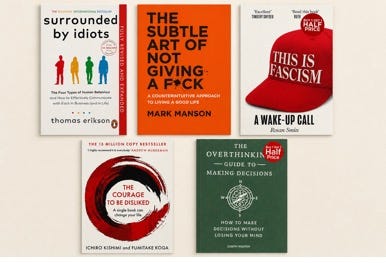
The mind as emergency: attention, approval, and the desire for relief.
Money is broken, and everyone knows it
The next theme is wealth, and here the shelf is openly at war with itself. On one side sit Rich Dad Poor Dad and How to Make a Billion in 9 Steps, still selling the old promise that anyone can climb if they learn the trick. Two feet away sit We Need to Tax Billionaires, Vulture Capitalism, and the Bank of England, gently asking Can’t We Just Print More Money?
That isn’t just a bookshelf. It’s an argument, and the argument is the point. I laughed when I saw How to Make a Billion and We Need to Tax Billionaires sharing a table. The same traveler was apparently free to want to win the game and challenge its rules in a single trip. The irony made me smile. The “Buy 1 get 1 half price” promotion made the pairing even better: critiques of capitalism and manuals for becoming rich, bundled by the same retail offer. The shelf suggested that the story many of us learned about how money works no longer feels convincing; even if the desire to get ahead remains.
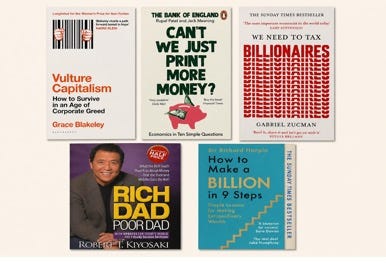
The shelf sells both the ladder and the argument against it.
Trying to make the world legible
Then came Prisoners of Geography and This Is Fascism: A Wake-Up Call. These are books for readers who may no longer assume the ground is stable. Geopolitics is repackaged as everything you need to know; fascism is sold as an alarm. I can understand the appeal. When the news arrives as a series of shocks, explanation can feel like a form of protection.
And then, the exits
When I travel, I prefer fiction so my favorite part of the shelf offered somewhere else to go other than a reality filled with contradictions. People We Meet on Vacation promised romance, with a Netflix sticker doing part of the selling. Lifelines: Searching for Home in the Mountains of Greece offered the fantasy of leaving for somewhere golden. The quieter outliers- Camus’s The Plague and Brian Friel’s Stories of Ireland- offered recognition rather than a solution.
Together these covers invite escape, relocation, belonging, and the chance to see a life differently. Those are needs too. At the same time, I thought to myself, some travelers would find it equally appealing to purchase one just to signal to other travelers an intellectual interest in literature.
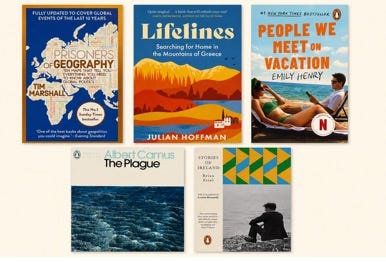
Maps, departures, and different versions of home.
What is missing from the shelf?
Can you tell me? Is it obvious? The world, at least at Heathrow and this bookstore, is much more secular. I don’t think I missed it, but not a single book cover was on faith. Another set of missing books was biographies - not Elon, Steve Jobs, or the usual international figures you might expect.
What does this ask of us?
Traveling alone and in my own thoughts, I thought that there are plenty of ways to read a shelf of book titles, and this was only one display in one airport. Still, the titles looked less like a catalog of wants than a collection of unresolved needs printed in bold.
Yet there may be a message for anyone building a product, a company, a policy, or looking to build a new remedy to the problems these titles suggest.
Three questions stayed with me.
What are we doing to people’s attention? Half of these books are about trying to quiet the mind, while much of what we build is engineered to grab, ping, and hold. Perhaps the more useful design goal is not capturing attention but deciding when it deserves to be left alone.
Where does the design expect trust it has not earned? Skepticism is no longer an edge case. Institutions, brands, and experts increasingly have to show their work. Confidence is not a substitute for transparency that people can inspect and test for themselves.
Are we making life better, or simply making escape easier? The wealth and travel books expose the same tension in different ways. People want to get ahead, get out, or begin again. A useful design can help. A better one might also ask what made the exit feel necessary.
By the time I left the shop and moved on to my departure gate, the shelf seemed to be saying something fairly simple: we are overwhelmed, distrustful, and often tempted by the idea of being somewhere else.
I don’t take that as cause for despair. It is a clear brief for builders—and an uncomfortable one. The question is whether we merely design for the anxieties on that shelf, or build things that give people fewer reasons to feel them.
Thanks for reading. Subscribe for free to read my observations on life, society, and more.