Every now and then, a political fight touches on work I care deeply about: expanding educational opportunity, strengthening our workforce, and respecting the choices Arizona voters make for themselves.
Last week, the U.S. Department of Justice sued Arizona over Proposition 308, the voter-approved law allowing students who attended an Arizona high school for at least two years and graduated here to qualify for in-state tuition regardless of their immigration status. The Department argues that Arizona’s policy conflicts with federal law governing benefits for undocumented immigrants.
Thanks for reading. Subscribe to hear my observations on civics, education, and the importance of common knowledge to strengthen our society.
Whether the federal government prevails is now a question for the courts. Thankfully, Arizona’s Attorney General Kris Mayes is defending the voters' preference.
But there’s another question worth asking, one that goes well beyond who is eligible for in-state tuition rates or the more complex questions surrounding immigration: how much discretion should states have to solve their own workforce and education challenges?
Arizona voters answered that question in 2022.
Legislators did not quietly enact Proposition 308. Arizona voters debated it publicly and approved it directly.
Arizona asks its young people to stay in school, work hard, graduate, and prepare for a future in which they can support themselves, their families, and their communities. Proposition 308 asks whether that promise should mean something.
In 2022, Arizona voters answered yes. They approved a straightforward policy: students who attended Arizona high schools for at least two years and earned an Arizona diploma should have a meaningful opportunity to continue their education at Arizona’s public institutions.
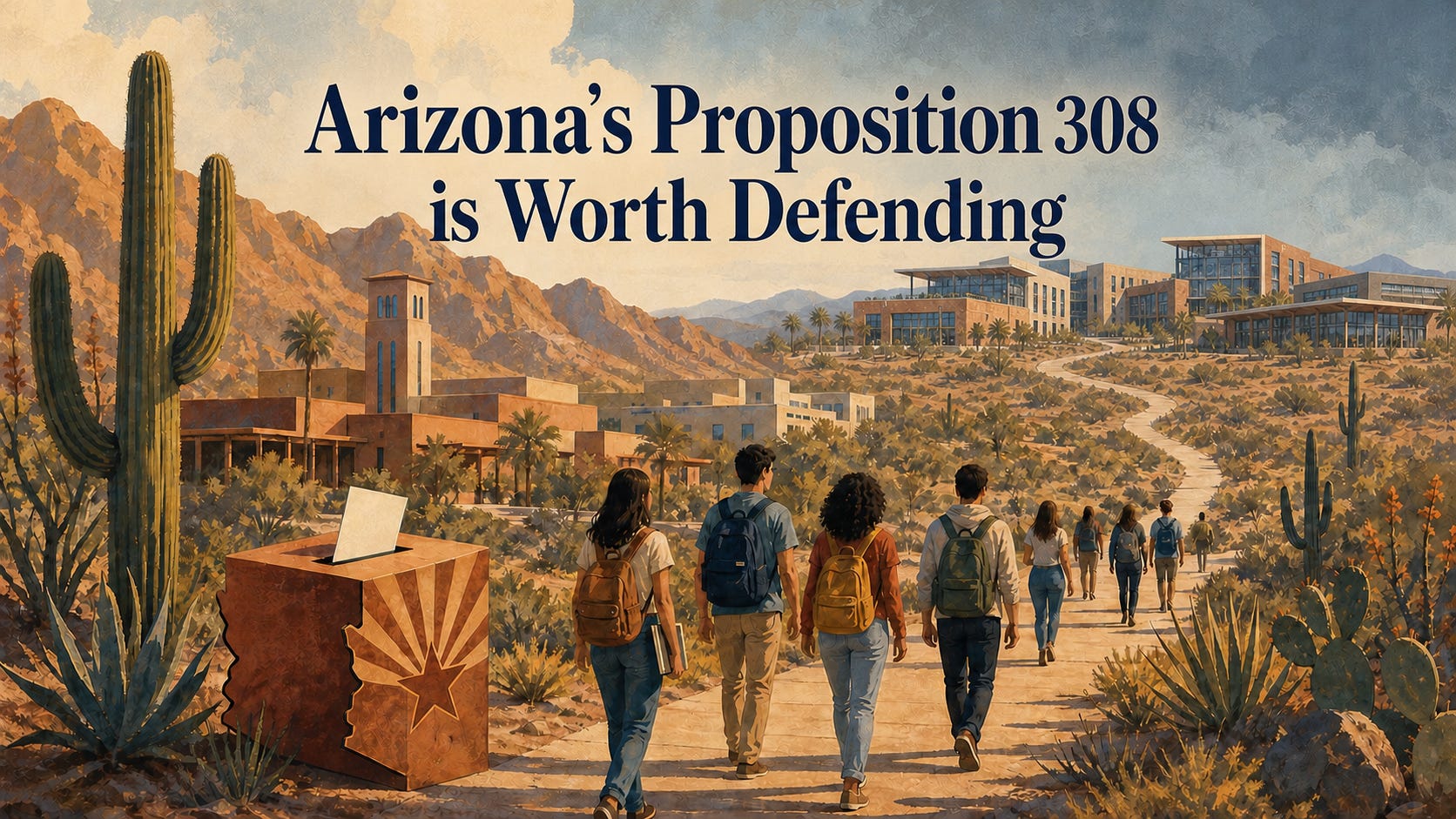
Reasonable people can disagree with that policy. But it is worth recognizing what Arizona voters were trying to accomplish. They were deciding how Arizona should invest in young people who have already become part of Arizona’s communities, schools, and future workforce.
None of that settles the legal question the Justice Department is raising. Yet, it is hard to understand the federal government’s assertion that other Arizonans’ rights were somehow violated by offering a reduced tuition rate to undocumented but qualified students.
Some of my friends might argue that the federal government also brought a case against Arizona SB 1070 (2010) → Arizona v. United States (2012). At the time, the DOJ sued Arizona because the state was doing more immigration enforcement than Washington wanted, not less. The Supreme Court struck down most of the state law as preempted by federal authority.
In my opinion, providing reduced tuition rates to undocumented students does not violate other citizens’ rights.
Imagine the DOJ pursuing states that provide these benefits:
Public Library: Imagine a public library deciding to waive late fees for children during the summer to encourage reading. Other community members haven’t lost a right. They still have access to the same books, library, and services. The community simply chose to remove a barrier for one group because it believed doing so served a broader public purpose.
Senior Discounts: Every day, governments and private organizations offer reduced prices to seniors, veterans, or students. We don’t typically describe those policies as violating everyone else’s rights. We recognize them as policy choices communities make to advance particular social goals.
Merit Scholarships: When a university awards a merit scholarship to an exceptional student, other students haven’t been deprived of a right. They remain free to attend under the published tuition rates. The institution simply chose to reduce the cost for one student because it believed doing so furthered its educational mission.
Local Property Tax Exemptions: Arizona communities routinely provide property tax exemptions or incentives for veterans, seniors, or economic development. Whether one agrees with those policies or not, we generally understand them as choices made by elected representatives—not as violations of everyone else’s rights.
Compared to these examples, the Justice Department’s case against Proposition 308 is just an attempt to score points.
Regardless of where one stands on immigration reforms, this moment raises an important question about the relationship between federal authority and state self-government. But the federal government’s approach obscures a fundamental principle that deserves equal attention: local communities often understand their own needs better than Washington does.
In 2022, Arizona’s voters weighed competing values and made a choice. If that choice conflicts with federal law, the courts should say so. If it does not, Arizona’s decision deserves respect.
As our nation becomes increasingly polarized, it is tempting to treat every disagreement as a national battle requiring a national solution. Yet one enduring strength of the American republic has always been allowing different states to pursue different approaches while remaining united under a common Constitution.
Sometimes those experiments succeed. Sometimes they fail. But allowing citizens to make those choices locally has long been one of America’s greatest institutional strengths.
For me, this issue is less about politics than about education, workforce development, and democratic legitimacy. This is why I keep believing local decision-making deserves the benefit of the doubt.
Communities closest to a problem often understand it in ways Washington cannot. They know their employers, schools, and families, and most importantly, they live with the consequences of the choices they make.
When decisions are made locally, people are also more likely to get involved, hold leaders accountable, and understand the tradeoffs at stake. That’s where trust comes from: people believing their voice matters, and that the rules reflect the reality of their own community.
Strong civic institutions are built from the ground up. Preserving room for states and local communities to solve their own problems isn’t just constitutional theory. It’s part of why the American system has worked as well as it has.
Thanks for reading. Subscribe to hear my observations on civics, education, and the importance of common knowledge to strengthen our society.