Very pleased to see the Phoenix Business Journal publish an article by Adam Goodman, Catherine Alonzo and myself.
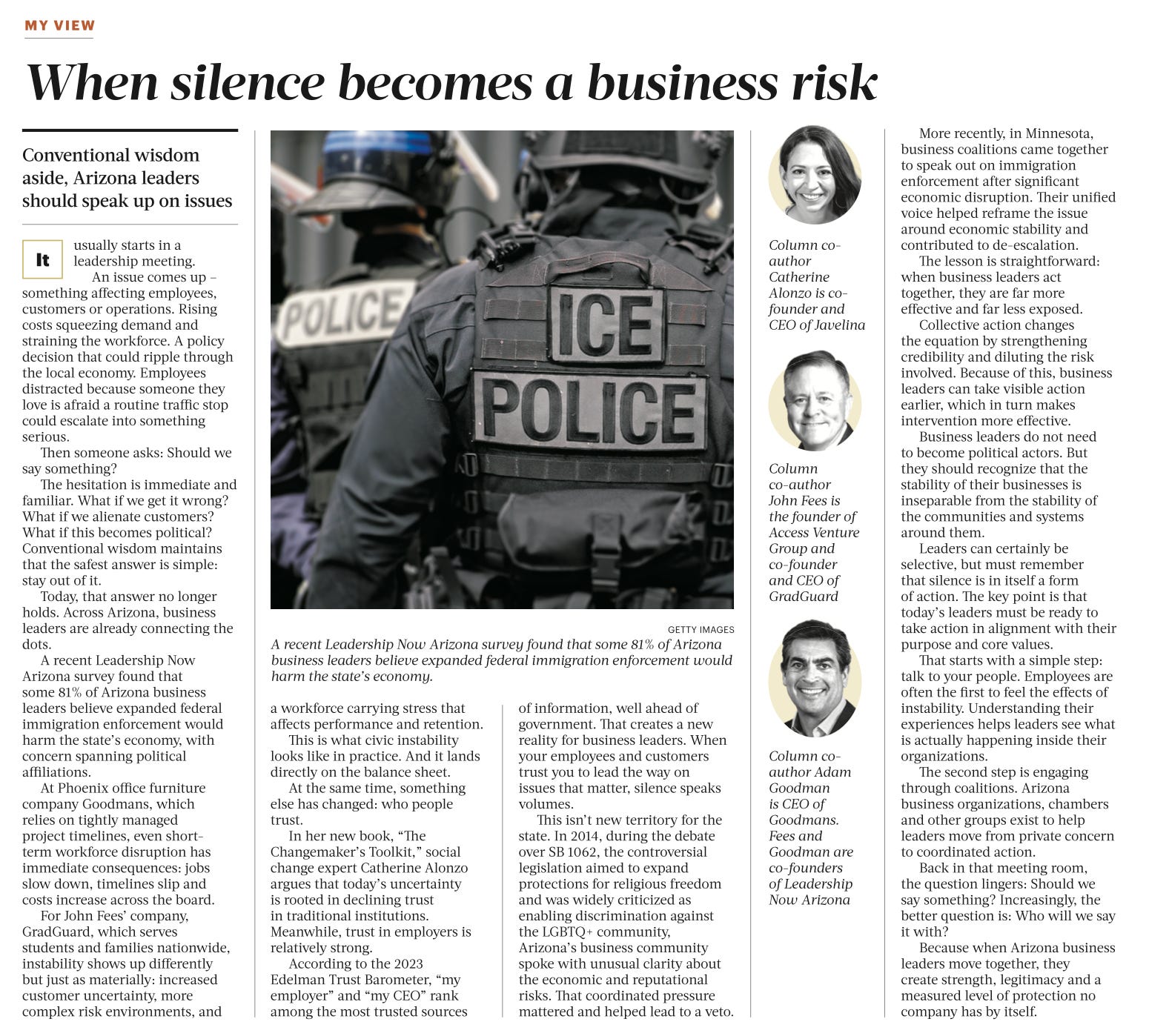
The article is a good example of the value of how speaking up with others is more useful than speaking up alone.
Subscribe for free to receive new posts and join me in discussions that I believe are vital to strengthening our community.
Here is an early and longer draft of our collaboration. I invite comments and happy to find other community leaders to speak with through or work with the Leadership Now Project.
It usually starts the same way.
An issue comes up in a leadership meeting — something affecting employees, customers, or the broader community. Maybe it’s immigration enforcement disrupting the workforce. Maybe it’s the fear employees carry when someone they love worries that a routine traffic stop could become something far more serious because of how they look. Maybe it’s rising costs putting pressure on families, employers, and local communities all at once. Maybe it’s a policy decision that could ripple through the economy.
And then someone asks the question:
Should we say something?
Almost immediately, the hesitation follows.
What if we get it wrong?What if we alienate customers?What if this becomes political?
For years, conventional wisdom offered a simple answer: stay out of it.
That answer no longer works.
Because the truth is this: when instability reaches your workforce, your customers, and your community, it is already a business issue.
Across Arizona, business leaders can feel that reality. They see these pressures showing up inside their companies and around them. But many still worry that speaking up creates more risk than staying silent.
That instinct is understandable. But in this environment, silence is not neutral.
Silence is a choice. And Because increasingly, it is a costly one.
Trust has shifted — and business leaders need to recognize what that means
One of the defining features of this moment is a collapse of trust in many of the institutions that once held public confidence. In The Changemaker’s Toolkit, Catherine Alonzo — my co-author in this piece — argues that much of what feels overwhelming today is tied to that erosion of trust.
At the same time, one institution has remained unusually credible: the workplace.
According to the Edelman Trust Barometer, people consistently rank “my employer” and “my CEO” among the most trusted voices in society — well ahead of Congress and many other public institutions.
That matters.
Because trust is not just a privilege. It is a form of responsibility.
If people trust business leaders more than public institutions to tell the truth, then business leaders do not have the luxury of pretending these moments are not theirs to lead through.
Civic stability is an economic issue
Too often, business leaders are encouraged to think of public/civic issues as separate from business performance.
They are not.
Stable democratic institutions, predictable policy, and community trust are not side issues to economic growth. They are the operating conditions that make growth possible.
When those conditions weaken, businesses feel it quickly: in workforce disruption, in recruiting and retention, in consumer confidence, in operating costs, and in the overall health of the communities they depend on.
This is not theoretical.
Earlier this year in Minnesota, immigration enforcement actions created significant disruption for local communities and employers. One analysis estimated the economic impact at roughly $200 million, including $80 million in direct losses to local businesses and restaurants.
That is what civic instability looks like when it hits a balance sheet.
A healthy economy cannot be built on fear, instability, and institutional distrust.
That is not a political statement.
They do.
The real question is business leaders are willing to respond before the damage compounds.
Business voice matters most when it is coordinated
The good news is that business leaders do not have to navigate these moments alone.
In Minnesota, companies and business coalitions came together to speak publicly about the economic and community consequences of immigration enforcement policy. They signed onto a shared statement that helped reframe the issue around economic stability and community impact — and their coordinated voice contributed to de-escalating the situation.
That matters.
Because one of the greatest barriers to business leadership is not disagreement.
It is isolation.
Many CEOs are not unwilling to lead. They are simply reluctant to stand alone.
That is why collective action matters so much.
Courage is easier to find when you are not the only one standing.
When business leaders move together, they create strength, legitimacy, and a measured level of protection no company has by itself.
Arizona has seen this before.
In 2014, when SB 1062 threatened both the state’s reputation and its economic competitiveness, Arizona’s business community stepped forward. The bill was widely criticized as enabling discrimination against the LGBTQ+ community, triggered a coordinated response from and business leaders inside and outside the state made clear that the reputational and economic costs would be real. That unified pressure mattered. Governor Brewer vetoed the bill.
It was a reminder that when business leaders act together — clearly, credibly, and with conviction early — they can shape outcomes that matter to the future of the state.
So what should leaders actually do?
Start with your people.
If you want to understand whether instability is affecting your business, do not begin with headlines. Begin with the people inside your organization. Employees are often the first to feel the impact of policy shifts, community fear, and economic uncertainty.
Listen closely enough, and they will tell you what is really happening long before a dashboard or quarterly report does.
Then recognize the power of acting with others.
Business organizations, chambers, and groups like Leadership Now Arizona exist for exactly this reason: to help leaders move from private concern to public clarity.
Not every issue requires a statement. Not every moment calls for a press conference. But every serious leader should know when silence becomes its own kind of message.
And increasingly, it does.
Organizations, chambers, and groups like Leadership Now Arizona exist for exactly this reason: to help leaders move from private concern to public clarity.
This is not about becoming political, Business leaders do not need to become activists or partisan actors. But they do need to understand something fundamental:
The long-term health of business is inseparable from the long-term health of the community, civic norms and institutions around them.
That is not politics. That is leadership. “Silence is not neutral. Silence is a choice. And increasingly, it is a costly one.”
Back in that meeting room, the question will keep coming:
Should we say something?
More and more, the better question is:
Who will we say it with?
Because no business leader should have to do this alone.
And when business leaders move together, they do more than protect their companies.
They help preserve the conditions that allow free enterprise — and free communities — to survive and thrive.
Subscribe for free to receive new posts and join me in discussions that I believe are vital to strengthening our community.