Thirty years ago, when I first read Alvin Toffler’s Future Shock, I remember thinking much of it felt exaggerated. Surely the human mind would adapt before information overload became the defining condition of modern life.
I was wrong.
Thanks for reading. I promise to share my honest observations that I think are vital to consider. Most are curated ideas at the intersection of business, civics and leadership.
Today, the volume of information, outrage, commentary, and distraction is relentless. Most of us wake up and immediately begin drinking from a firehose. That is why trusted filters matter so much. Over time, I’ve learned to rely on a small number of people who consistently separate signal from noise.
One of those voices for me has been Axios CEO Jim VandeHei.
Over the weekend, VandeHei shared a summary from his new C-suite newsletter that crystallized something I’ve been wrestling with for months:
“We’re living through the most disorienting societal moment since World War II. Almost nobody in a position of power is explaining why, or what to do about it.”
He continued:
“This is so much bigger than politics. It touches our jobs, our companies, our communities and our realities.”
Then came the part that really stayed with me. Despite Americans being wealthier, safer, and longer-lived than at almost any point in history, trust in nearly every major institution continues to collapse. Consumer sentiment is near historic lows. Confidence in government, media, higher education, organized religion, and even science has eroded dramatically.
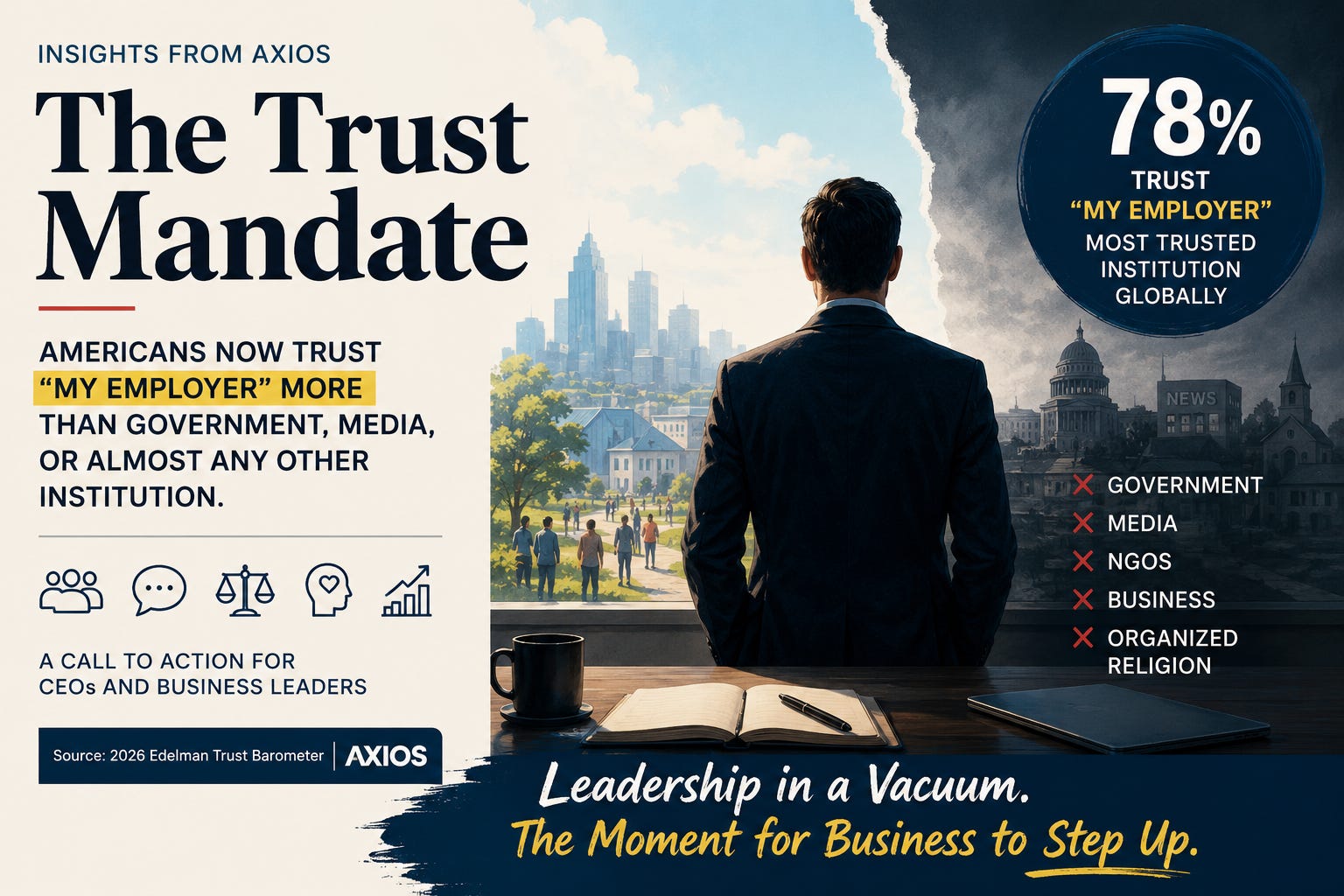
And yet one institution stands apart.
According to the 2026 Edelman Trust Barometer, Americans now trust “my employer” more than government, media, or almost any other institution.
It is tempting to interpret this as a victory for business. I don’t think it is. I think it is evidence of institutional decline.
When confidence erodes in government, universities, churches, media, and civic organizations, the human need for leadership and stability does not disappear. People simply begin looking elsewhere for it. Increasingly, they are finding it — or hoping to find it — at work.
Axios framed this as a moment for CEOs to step into a leadership vacuum. I agree. But I also think the challenge is larger than communication strategy.
The deeper challenge is whether leaders are willing to help rebuild trust itself.
That starts with honesty.
Employees do not expect certainty. But they do expect candor.
One of the advantages of getting older is becoming more comfortable admitting how often you were wrong. I certainly have been. I’ve started businesses that missed projections repeatedly before succeeding anyway. I’ve made strategic decisions that looked smart at the time and terrible six months later.
Most entrepreneurial progress comes from some combination of optimism, conviction, and the willingness to move before the evidence is fully settled. That is a landscape certain to include mistakes. The best entrepreneurs I know were lucky to be right more than they were wrong, but they are not perfect.
Indeed, being wrong is not the same thing as being dishonest.
For years I’ve admired Max De Pree’s idea that the first responsibility of a leader is to define reality. That sounds straightforward until you actually try to do it during periods of uncertainty.
Right now, reality includes economic anxiety, declining trust in institutions, political fragmentation, and the rapid arrival of AI into nearly every profession.
Most organizations are still trying to determine whether AI represents leverage, disruption, displacement, or some combination of all three. Employees deserve more transparency than they are getting. They want to know what is actually changing, which skills will matter, what leadership truly believes, and whether the organization intends to invest in them during the transition.
The truth is that many leaders do not fully know yet.
Ironically, admitting that uncertainty may be one of the few things that still builds trust.
I also appreciated Axios emphasizing character and competence. Durable institutions require both. Merit matters. Accountability matters. Fairness matters. Not as slogans, but as operating principles people can actually see and feel.
Another point that deserves more attention is the visible erosion of civic confidence and patriotism, especially among younger Americans.
No company can solve that problem alone. But leaders can still model gratitude, stewardship, and responsibility toward the communities and country that made their success possible.
And leaders can — and I would argue must — defend the institutions that make free societies and free markets possible in the first place: the rule of law, fair elections, independent courts, and due process.
At their best, businesses do far more than generate profits. They create stability. Opportunity. Belonging. Upward mobility. They help people believe the future can improve.
That may sound idealistic. I increasingly think it is simply practical.
When traditional institutions weaken, people do not stop searching for leadership. They just change where they look for it.
Which leaves a harder question for those of us who lead organizations:
Are we merely managing companies, or are we also helping strengthen the social fabric around us?
Credit to Jim VandeHei and the team at Axios for starting a conversation worth having.
Thanks for reading. I promise to share my honest observations that I think are vital to consider. Most are curated ideas at the intersection of business, civics and leadership.